
Advancement offices promise donors a real relationship, then run that relationship through a spreadsheet. An AI agent can close the gap between a pledge and a payment without making alumni feel like a line item.
AI Adoption · Education
What’s happening now
Advancement and alumni-relations teams are small relative to the number of alumni and donors they’re responsible for, and the gap between a pledge and an actual gift is where a lot of committed revenue quietly disappears. A pledge made at a gala or in a one-on-one meeting with a gift officer still has to turn into cash: a follow-up email, a reminder before each installment is due, a thank-you, an update on how the money is being used. Every one of those steps is manual today at most institutions, and manual steps are the first thing to slip when staff are stretched across event season, prospect research, and donor visits.
Two failure points show up again and again. A multi-year pledge spread over three or five years needs a reminder sent at the right interval — not a generic quarterly email blast — or the donor simply forgets an installment was due. A matching-gift submission runs on a deadline set by the donor’s employer, not by the school, and if nobody flags it in time, an already-committed gift never gets matched at all. Add staff turnover, which advancement offices see more than most departments, and a pledge’s entire follow-up history can live in one departed employee’s inbox.
None of this is a fundraising problem in the usual sense — the gift was already committed. It’s a follow-through problem, and it’s exactly the kind of repetitive, schedule-driven work that doesn’t need a gift officer’s judgment so much as it needs someone — or something — that never forgets.
How an AI agent can be deployed
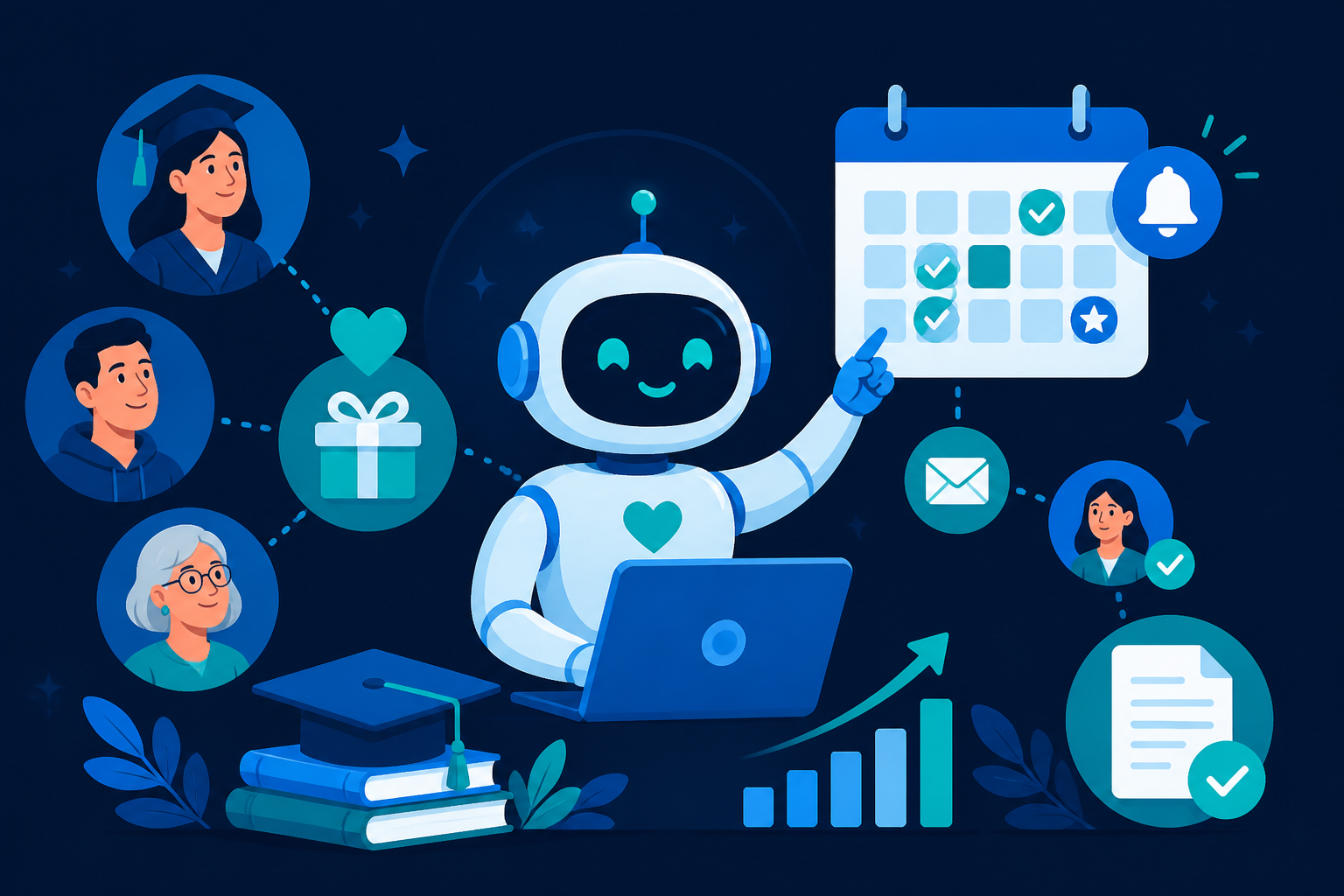
An AI agent built for alumni and donor relations sits alongside your existing CRM or donor database, watching pledge records and gift schedules the way a diligent, tireless member of the advancement team would. It doesn’t replace the gift officer relationship — it makes sure nothing committed to that relationship falls through an administrative crack.
- Tracks every multi-year pledge installment and sends a donor reminder timed to the pledge’s own schedule, not a one-size-fits-all calendar.
- Flags matching-gift opportunities by checking whether a donor’s employer offers one, then surfaces the paperwork and deadline to both the donor and the gift officer before it lapses.
- Drafts personalized stewardship updates — a short note on how a gift is being used — pulled from program updates, with a human reviewing and sending rather than writing from a blank page.
- Surfaces lapsed or at-risk pledges by watching for missed installments or stalled communication threads, routing them to a gift officer before the relationship goes cold.
- Coordinates event RSVPs and follow-up for reunions, galas, and donor briefings, including thank-you notes tied to what each attendee actually committed to.
- Logs every touchpoint back into the CRM automatically, so the next staff member to pick up a donor relationship — including after turnover — isn’t starting from a blank file.
Every outbound message a donor actually sees still goes through a human review step before it sends, and every flagged pledge still gets a judgment call from a person who knows the donor — the agent’s job is to make sure that judgment call happens at all, on time. Integration runs against whatever CRM, donor database, or even spreadsheet system the advancement office already uses, and a focused pilot — one pledge segment or one reunion class — can typically be running within a few weeks.
A pledge isn’t a gift until it’s paid. Everything between the handshake and the deposit is where good intentions quietly expire.
What are the benefits
Institutions that put an agent on pledge follow-up tend to see the effect less in any single flashy number and more in what quietly stops falling through the cracks.
- Higher pledge fulfillment rates because reminders go out on schedule instead of whenever staff get to them.
- Fewer missed matching-gift windows, which otherwise represent committed revenue the institution never actually collects.
- Faster continuity after staff turnover, since pledge and donor history live in the system instead of in one person’s inbox.
- More gift-officer time spent on relationships, not reminders — the work that actually grows a donor’s giving over time.
- A more consistent donor experience, since stewardship updates and thank-you notes go out reliably even during the busiest parts of event season.
- Better visibility for leadership into which pledges are on track, which are at risk, and where the advancement team should focus next.
The institutions that get the most out of this aren’t the ones that bolt on an agent and walk away — they’re the ones that treat it as one more member of the advancement team, with clear rules for what it can send on its own and what still needs a human signature. That’s a deployment decision, not a technology one, and it’s where a structured rollout pays off.
Get started with Atom8
Atom8 helps small and mid-sized businesses move past AI curiosity into
real, measurable adoption. We assess your processes, identify high-impact
use cases, build and integrate the solution, and train your team so adoption
sticks. We’re platform-neutral and partner with you end to end — from
strategy through deployment and long-term support.
Ready to stop losing committed gifts to busywork?
Book a conversation with Atom8 to see where an AI agent fits into your advancement workflow.